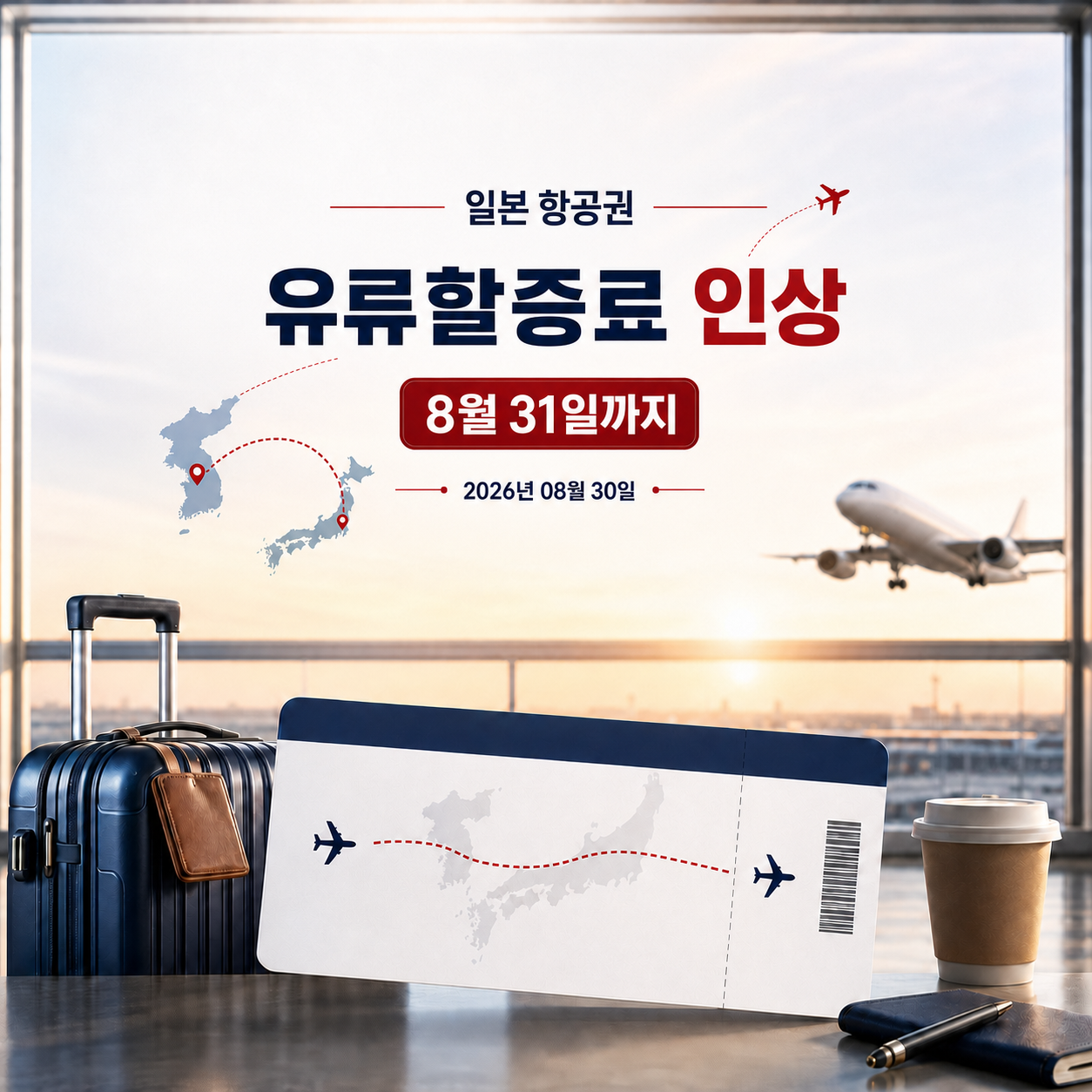
For Japan flights departing South Korea on Korean Air or Asiana, the original emphasized ticket-issue date rather than departure date. September 2026 surcharges rose for tickets issued from September 1; tickets fully paid and issued by August 31 used August’s schedule. These are historical South Korea-departure charges, not US-origin or current surcharges.
JAPAN NOW · KOREA DEPARTURE FARE
Japan-flight fuel surchargesHigher for September ticket issuance
The listed one-way Japan-route increases were up to KRW 16,400 on Korean Air and KRW 23,100 on Asiana. For an already fixed itinerary, the original suggested comparing the final payable total before August 31.
Even for travel from September, issuance by August 31 used August’s surcharge. Starting a reservation in August but completing payment/issuance September 1 or later could use September’s schedule.
Korean Air’s Japan-route increases
The main list included Nagoya, Tokyo Narita, Osaka, Sapporo, Okinawa, Gimpo–Tokyo Haneda, and Busan–Tokyo Narita. Busan–Fukuoka used the same Fukuoka amount.
Asiana’s Japan-route increases
The short-distance group covered Fukuoka, Miyazaki, and Kumamoto; main routes covered Kobe, Osaka, Nagoya, Tokyo, Okinawa, Sendai, and Sapporo. Asiana said fuel surcharges applied to mileage-award as well as ordinary paid tickets.
The official tables were per person, per segment departing South Korea. A Japan-origin return could use different local rules, and multi-city, codeshare, and currency conditions could change the total. The final checkout’s tax/fee breakdown was the relevant total.
Conditions for South Korea departures
This was a cost notice based on departure from South Korea, not a nationality discount. Non-Korean travelers starting there could also check the same ticket-issuance conditions; travelers departing the US should not apply this table to their US-origin segments.
Both carriers applied the new figures to tickets issued during September 2026. Later months could change with oil prices and exchange rates.
No fuel surcharge applied to an under-two infant not using a separate seat in the source guidance. A purchased seat or other fare conditions needed checking on the actual payment screen.
Both airlines said later surcharge rises/falls did not trigger extra collection or a refund after ticket purchase.
Korean Air and Asiana’s Korean sites provided route amounts and periods. The original recommended checking the newest notice before booking.
This surcharge notice did not separately establish overseas-card restrictions. Accepted cards, payment currency, and authentication depended on actual ticket checkout.
The original August 31 payment checklist
- Confirm issuance is complete with a ticket number, not only a held booking.
- Compare both airlines’ final totals and baggage for equivalent flights.
- Use the return checkout’s actual taxes/fees, not twice the one-way table.
- Consider change/refund costs and itinerary certainty before surcharge savings.
- For Asiana mileage tickets, check cash surcharges alongside required miles.
- For infants, check how separate-seat use affects the actual breakdown.
EDITOR'S NOTE · EVERYDAY TRIP
EVERYDAY TRIP Editorial Team’s advice
Earlier issuance avoided that announced September increase, but the base fare itself could move. Compare the checkout total and equivalent baggage-inclusive totals before payment, in the historical context of that deadline.
Saving roughly KRW 10,000–20,000 in surcharge could be outweighed by a larger date-change fee. With leave or companions’ dates unconfirmed, flexibility could matter more than cheaper issuance.
Doubling a South Korea-origin one-way table could distort a return budget, particularly on open-jaw/multi-city trips with different issuing/currency conditions. Read each segment’s checkout taxes.
Lap infants under two were excluded, but children using ordinary seats and award tickets could still have cash charges. Compare the whole party’s fare, fuel surcharge, and taxes.